Good design happens at the intersection of discovering real user needs/wants and business goals that are ACTIONABLE (by design and engineering). Yes, there’s a little magic/instinct that creeps into good design too, but you can get far without a lot of this magic. It’s really more about nailing the problem set, and having really clear … Read more

Good Design–what I sometimes call—”Capital D Design”—has the power to make your data sing, delight customers/users, bring new/better ROI to your organization, provide inspiration to teams, reduce complexity, reduce engineering cost, save time for users, and expose new value in your existing service. However, the big gains usually don’t come from focusing on the surface level alone. Better data visualization cannot fix every data product and analytics problem.
I know to a lot of software teams, getting features/fixes/releases out the door feels like improvement. However, did you actually create or improve the value of your service? To to that, you have to understand what your users actually value, so you can align your efforts accordingly. Most of the time, these nuggets of useful … Read more
Should maximum simplicity dictate success? We all love usability these days right? “User experience is important.” Of course it is! But, it doesn’t mean that every user you show the design to is going to, or should immediately be able to, understand fully what you’re showing them. Why? Most valuable things in life take a … Read more

…or not. Really: you can spend a little more time, and probably a lot less money, doing these things before committing the resources to implementation of something that may have zero value to anyone.
Some of you probably know by now that I’m also a musician, and this includes composing for my instrumental jazz/chamber music quintet. What does this have to do with translation of your data? When I talk about data in on the DFA mailing list, I’m usually talking about the raw ingredients that may (or may … Read more
Readers of DFA know that I’m big on not immediately giving customers what they asked for, and instead asking the question “why” to learn what the real latent customer needs are. And for you internal analytics folks, remember your employees, vendors, etc. are your “customers” whether you think of them that way or not! Anyhow, … Read more
Ok, you probably know this one, but let’s dig in a little farther. I recently started to explore using the TORBrowser when surfing on public wi-fi for more security (later finding out that using a VPN, and not TOR, is what will enable safer surfing). However, in the process of downloading and trying the TORBrowser … Read more
Today’s insight was originally inspired by a newsletter I read from Stephen Anderson on designing for comprehension, and I felt like this could be expanded on for analytics practitioners and people working on data products. One of the recurring themes I hear from my clients is around the topic of general engagement (or lack thereof) … Read more
When I work on products that primarily exist to display analytics information, I find most of them fall into roughly four different levels of design maturity: The best analytics-driven products give actionable recommendations or predictions written in prose telling a user what to do based on data. They are careful about the quantity and design of the … Read more
I ran into a an article about the Chief Data & Analytics Officer, Fall conference that summarized some of the key takeaways at the previous year’s conference. One paragraph in the article stuck out to me: … The Great Dilemma – Product vs Project vs Capability Analytics Approaches Although not one of these approaches will provide a … Read more
I’m working with a large, household-name technology company right now on a large project, and they struggle with one of the same things so many of my clients struggle with. Today’s topic is articulating use cases and goals in an effective manner that allows your design and development to proceed with clarity and accountability. If … Read more
Today I want to respond to a reader who answered a previous email I sent you all about your top concerns designing for analytics. Here’s Évans’ email: +++++ In analytics, it’s not like a CRUD [Create-Read-Update-Delete] with a simple wizard-like workflow (Input – Validate – Save). It’s kinda hard to keep the user focused when there are … Read more
Today I got an interesting anomaly email from a service I use called Next Big Sound. Actually, I don’t use the service too much, but it crosses two of my interests: music and analytics. Next Big Sound aggregates music playback data from various music providers (Spotify, Pandora, etc) and also, apparently, tries to correlate changes … Read more
(As shown to customers in your UI) I’m talking to a prospective SAAS client right now, and they’re trying to expose some analytics on their customers’ data so that the customers can derive ROI from the SAAS on their own. The intent is that the data can also be useful to the SAAS sales team, … Read more
If you are starting out on a new feature design, or analytics effort, can you clearly state what the value will be in quantifiable terms at the end of the sprint? Are you building an “exploratory” UI, or one that is supposed to drive home conclusions for the customer? When clients come to me about … Read more
Post-truth. The 2016 word of the year. Yikes for some of us. This got me thinking about UX around data, analytics, and information, and what it means when we present conclusions or advice based on quantitative data. Are those “facts”? If your product generates actionable information for customers, then during your design phase, your team … Read more
Try cutting features out of it. Apparently, that whole quote from Michaelangelo about “I just carve away the part of the statue that doesn’t look like David” is a myth. But, it’s a good myth for design thinkers. It helps me remember that you can add customer value by removing materials from a design. We talk a … Read more
I loved this quote: ”Identify 2-3 need-to-know insights, and make that the focus of the product. Rather than thinking about competing products, think about competing processes. The goal of the product is to be consistently used by all users, not just power users, and the only way to accomplish this is to make it as simple as possible to discover the … Read more
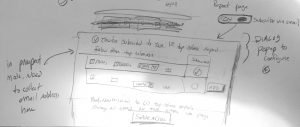
You can save $10,000 / week pretty easily through better design. One of the values that clients don’t always understand is that good design not only improves customer experience and drives revenue, but it also reduces time wasted on engineering the wrong product/feature/design. My solution to this is to get design involved ahead of engineering … Read more